Most homeowners assume siding is priced the same way you’d price a roll of carpet — you measure the square footage, multiply by a rate, and that’s your number. If only it were that simple. House size does drive siding cost, but it’s not the only thing that does, and understanding the relationship between the two will help you read a quote intelligently and avoid being caught off guard by a number that seems higher than expected.
Here is what actually happens when a contractor prices a siding job in Metro Vancouver, and how the size and shape of your home feeds into that final figure.
Wall Surface Area Is What Actually Gets Measured
The first thing to understand is that siding is priced on exterior wall surface area, not on the overall square footage of your home. A 2,500 square foot house with a compact two storey footprint will have significantly less wall surface than a sprawling single level rancher of the same floor area. Contractors measure the actual cladding area — every wall face, every gable end, every return around windows and doors — and that measured area is what drives the material and labour estimate.
As a rough guide, a single level rancher with 1,800 square feet of interior floor space typically has around 1,800 square feet of exterior wall surface too, which is why that size is used as the standard baseline for most siding quotes in the Lower Mainland. A two storey home with the same floor plate has considerably more wall area because the second floor adds height to all four walls.
On the Affordable Siding BC website, our published pricing is based on exactly this: a standard rancher with approximately 1,800 square feet of exterior wall surface, ground level access, and minimal scaffolding required. That context matters because a home that deviates from those conditions in any direction will be priced differently.
How Different Home Types Price Out in Metro Vancouver
To make this concrete, here is how the main residential home types in the Lower Mainland translate into siding costs. These figures are for James Hardie fibre cement, which is the most commonly specified material for siding replacements in Vancouver, and they assume straightforward access with no significant complications.
| Home Type | Est. Wall Surface | Approx. Cost (Hardie Primed) | Approx. Cost (Vinyl) |
|---|---|---|---|
| Small rancher or townhouse | 1,200 to 1,500 sq. ft. | $13,000 to $16,000 | $9,500 to $12,000 |
| Standard rancher (baseline) | ~1,800 sq. ft. | From $16,650 | From $12,000 |
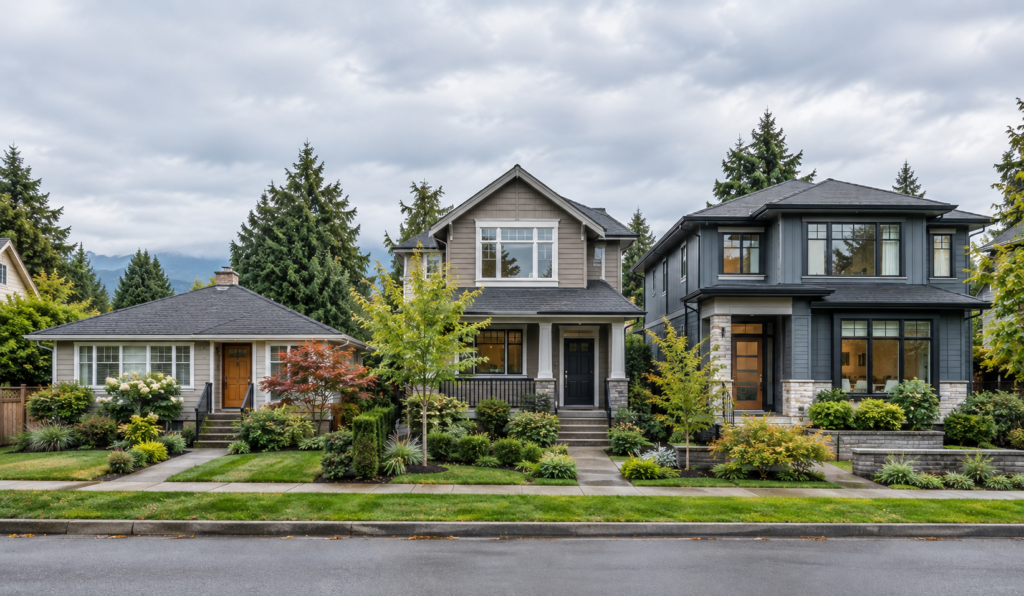
| Two storey detached home | 2,200 to 2,800 sq. ft. | $20,000 to $28,000 | $14,500 to $20,000 |
| Large two storey or custom home | 3,000 to 4,000+ sq. ft. | $28,000 to $45,000+ | $20,000 to $32,000+ |
Figures are estimates for Metro Vancouver in 2026 based on standard installations with ground level or minimal scaffolding access. Complex rooflines, mixed cladding, or difficult site access will increase these ranges.
Why Bigger Homes Don’t Always Cost More Per Square Foot
There is an economy of scale in siding that works in favour of larger projects, up to a point. When a crew mobilises for a job — bringing equipment, setting up, establishing their workflow — a meaningful portion of the project cost is fixed regardless of how much wall they’re covering. On a larger home that fixed cost is spread across more square footage, which is why the per square foot rate on a 3,000 square foot job is often slightly lower than on a 1,200 square foot job.
This is worth knowing if you are comparing quotes across neighbours or friends with different sized homes. A higher total quote on a bigger house does not necessarily mean a higher rate — it may simply reflect the additional material and time required. Always look at the per square foot figure when comparing quotes, not just the total.
The Factors That Matter as Much as Size
Size sets the baseline. But several other factors can push a quote up or down by thousands of dollars independently of how much wall surface area your home has. These are the ones that catch Vancouver homeowners most often.
Storeys and scaffolding requirements
A two storey home does not just add wall area — it adds height, and height costs money. Upper storey work typically requires scaffolding or elevated platforms, which add both rental costs and additional setup and takedown labour. In Metro Vancouver, scaffolding for a standard two storey home can add $2,000 to $5,000 to a project depending on the scope and duration. This is why two identical homes, one single storey and one two storey, can produce quotes that differ by more than just the proportional wall area suggests.
Roofline and architectural complexity
A simple rectangular box is the cheapest home to side. Every additional angle, gable, bay window, dormer, or curved surface adds cut pieces, waste material, and skilled labour time. Some Metro Vancouver homes — particularly custom builds in North Vancouver, West Vancouver, and newer developments in Langley — have highly complex rooflines that make what looks like a medium sized home price like a large one. An experienced contractor will identify this during a site visit.
Number of windows and doors
Every penetration in a wall — every window, door, hose bib, or electrical outlet — requires careful cutting, fitting, and flashing. More penetrations mean more time, and in a Vancouver climate where water intrusion around window and door frames is a common source of building envelope problems, this is not work you want rushed. A home with lots of windows is not necessarily larger, but it will take longer to side properly.
Rainscreen requirement
Every siding project in Metro Vancouver requires a compliant rainscreen installation behind the new cladding. This adds both material and labour cost across the full wall area. On a larger home, the rainscreen cost scales proportionally, so it amplifies the size effect. A 3,000 square foot wall surface needs significantly more rainscreen material than a 1,500 square foot one, and that difference shows up in the quote.
Condition of the existing substrate
Once the old siding comes off, what the contractor finds underneath can change the scope and cost of the project significantly. Rot, moisture damage, failed sheathing, or improperly installed house wrap from a previous renovation all need to be remedied before new siding goes on. Larger, older homes tend to have more of this than smaller newer ones, though it can appear anywhere. This is why quotes often carry an allowance or a note about substrate conditions.
The Most Expensive Mistake Homeowners Make
The most expensive mistake is trying to estimate your own project cost based on a neighbour’s quote without accounting for the differences between the two homes. A rancher two doors down got Hardie for $17,000, so yours should cost about the same. Except your home has a second storey, a complex bay window on the south face, and the original sheathing hasn’t been touched since 1987.
These details matter enormously, and they’re why every siding contractor worth working with insists on a site visit before providing a number. A quote given over the phone or based on floor plans alone is almost never accurate.
For a fuller picture of how Vancouver siding costs break down by material and what a proper all-inclusive quote should include, our guide to siding replacement costs in Metro Vancouver is a good starting point before you begin requesting quotes.
Getting a Quote That Reflects Your Actual Home
The only reliable way to know what your project will cost is to have a contractor come to the property, take proper measurements, assess the access conditions, and look at the existing wall surface. That process takes thirty to forty five minutes and should cost you nothing.
Our team at Affordable Siding BC provides free on-site quotes across Metro Vancouver and the Lower Mainland. We measure every home individually, explain exactly what goes into the number we give you, and back every installation with a five year workmanship warranty and a price match guarantee if you’ve received a comparable quote elsewhere.
About Affordable Siding BC: Locally owned and based in Delta, BC. Our own experienced crews handle every project across Greater Vancouver and the Lower Mainland — no subcontractors, no markups, no surprises.