Published: August 2026 | Category: Cost Guides | Reading time: 6 min
This is one of the most common questions we hear from homeowners in the Lower Mainland. You’ve been quoted somewhere between $12,000 and $30,000 for new siding, and before you commit, you want to know whether that money actually comes back when you sell. It’s a completely reasonable thing to ask.
The honest answer is yes, new siding does add measurable value to a Vancouver home. But the full picture is more interesting than a simple yes or no, because Vancouver’s real estate market has some specific characteristics that make siding replacement a stronger investment here than in most other Canadian cities.
What the Return on Investment Actually Looks Like
Based on 2026 renovation and resale data for Metro Vancouver, homeowners typically recover between 75 and 85 percent of their siding replacement cost when they sell. So if you spend $16,650 on a James Hardie installation, you can reasonably expect somewhere around $12,500 to $14,000 of that to be reflected in your sale price.
That might sound like you’re leaving money on the table, but that’s not really how to think about it. Very few home renovations return 100 cents on the dollar at resale. The relevant question is whether the return is worth it compared to your alternatives, and in Vancouver that calculation almost always tips in favour of upgrading.
Consider that buying and selling a home in Metro Vancouver typically costs $80,000 to $150,000 in transaction costs alone: agent commissions, legal fees, property transfer tax, and moving expenses. If you’re thinking about selling your current home and buying something better maintained, you might spend more on that move than you would on a full siding replacement. Staying put and investing in your existing home frequently makes more financial sense.
Quick numbers: On a $16,650 James Hardie installation, an 80% return adds roughly $13,300 in resale value. You also get years of better protection, lower maintenance costs, and a home that photographs and shows significantly better. The resale value is just one part of the return.
Why Vancouver Buyers Pay Attention to Siding
In most Canadian cities, siding is something buyers notice aesthetically but don’t necessarily scrutinise in depth. Vancouver is different. The city’s rainfall, humidity, and history with building envelope failures have made buyers and their agents considerably more attentive to what’s on the outside of a home.
When a Vancouver buyer’s agent walks up to a property and sees aging, cracked, or discoloured siding, they immediately start thinking about what might be happening behind it. Moisture. Rot. Possible remediation costs. Those concerns get priced into their offer, sometimes aggressively.
Fresh siding, on the other hand, sends the opposite signal. It tells a buyer that the home has been maintained, that the building envelope is sound, and that there are no expensive surprises waiting behind the walls. In a market where buyers are spending seven figures, that kind of confidence has tangible value.
It’s also worth noting that BC’s building code requires a proper rainscreen system behind any new siding installation. Buyers and inspectors know this. A home with a compliant, professionally installed rainscreen and fresh cladding over it represents a genuinely lower moisture risk than one without, and that shows up in how offers come in.
Which Material Gives You the Best Return?
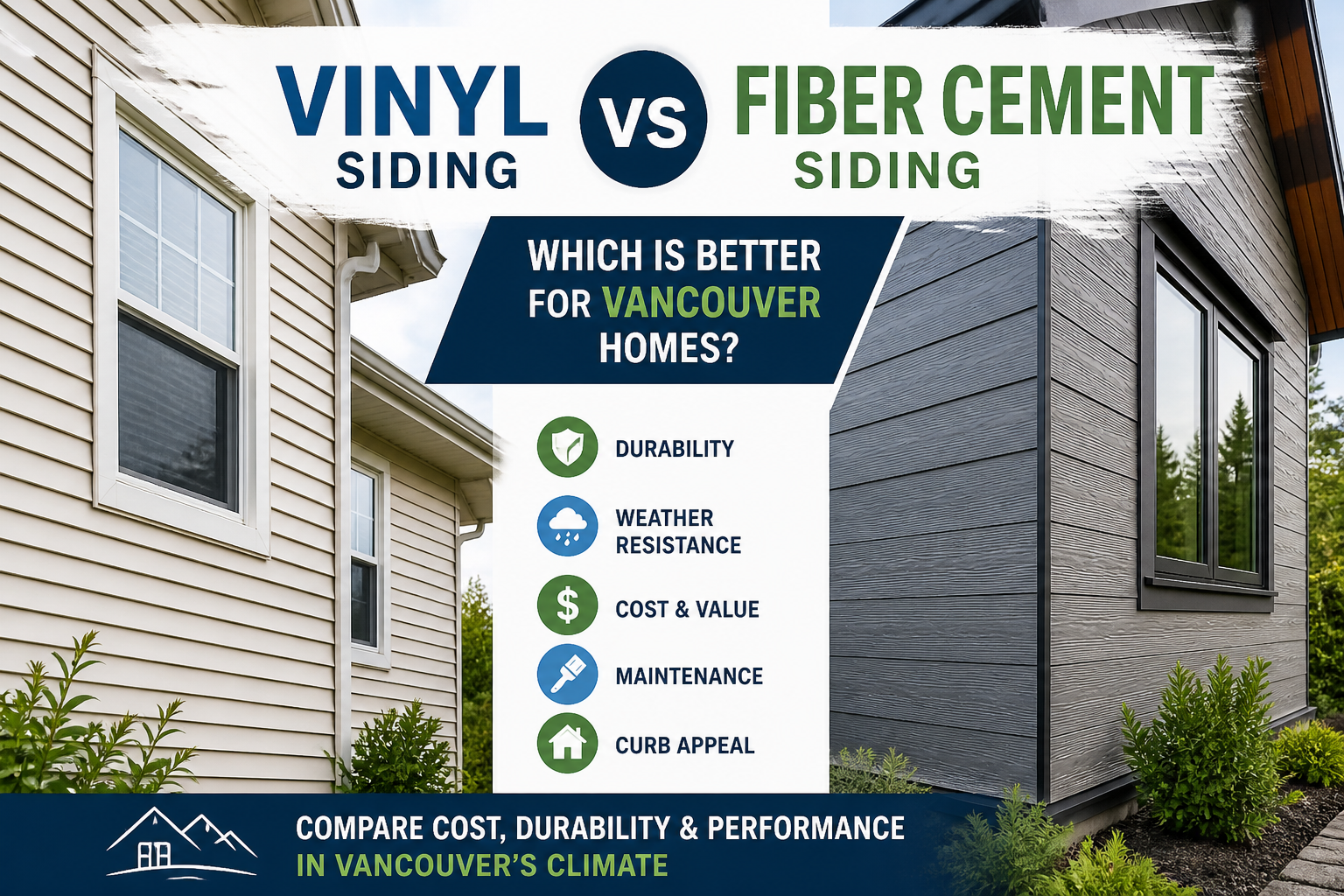
Not all siding materials return the same value at resale. Here is how the main options compare for a Vancouver home.
| Siding Material | Starting Cost (1,800 sq. ft.) | Typical ROI at Resale | Buyer Appeal |
|---|---|---|---|
| Vinyl Siding | From $12,000 | 65 to 75% | Good — clean, refreshed appearance |
| James Hardie Fibre Cement | From $16,650 | 75 to 85% | Strong — well recognised as premium |
| Cedar Siding | From $18,000 | 70 to 80% | Strong in the right neighbourhoods |
| Metal or Longboard | From $22,000 | 65 to 75% | High appeal in the contemporary market |
ROI estimates are based on 2026 Metro Vancouver renovation and resale data. Actual returns vary by neighbourhood, home condition, and market conditions at time of sale.
James Hardie fibre cement sits at the top of the range for good reason. It is a product that buyers in Vancouver recognise by name. It carries a manufacturer warranty that transfers to the new owner, which is a genuine selling point in a pre-sale disclosure context. And it is explicitly engineered for the wet Pacific Northwest climate, which matters to any buyer who has done their homework.
Vinyl siding returns slightly less at resale but is still a solid investment, particularly for rental properties or homes where the budget doesn’t support fibre cement. It will refresh the appearance of a tired exterior and remove siding as a negotiating point for buyers during inspections.
The Value You Live With Before You Sell
Resale ROI is only one dimension of what new siding returns. If you are not planning to sell in the next year or two, the ongoing benefits are just as important.
Maintenance costs go down considerably
Old or failing siding demands constant attention. Repainting, recaulking, replacing damaged panels, dealing with moisture issues as they surface. James Hardie siding properly installed needs very little beyond a wash every few years and a repaint somewhere between 15 and 25 years out depending on the finish. That is time and money you get to keep.
Your home insurance may improve
Some insurers factor the condition and material of your exterior cladding into your premium. Fire resistant fibre cement can reduce insurance costs by five to fifteen percent in some cases. One homeowner in Dunbar saved $680 per year after switching from cedar to Hardie. Over ten years that is nearly $7,000 back, which changes the ROI calculation meaningfully.
Energy performance improves
A properly installed rainscreen and new cladding creates a tighter, better performing building envelope. For older Vancouver homes built before modern energy standards, this can lead to real reductions in heating costs through the long wet winters. The savings are modest but consistent year after year.
You simply enjoy living in your home more
This is harder to put a number on but it matters. Homeowners who have dealt with building envelope issues know exactly what it is worth to close that risk off. New siding with a proper rainscreen behind it means one less thing to worry about when the November rains start.
When Does the Investment Make the Most Sense?
New siding makes the clearest financial case in a few specific situations.
If you are planning to sell in the next one to five years, fresh siding removes one of the most common inspection objections, dramatically improves how your home photographs for listings, and signals to buyers that the property has been cared for. In a competitive Vancouver market, all of those things affect what offers look like.
If your current siding is failing or showing signs of moisture infiltration, replacement is not really discretionary. The cost of dealing with rot and moisture damage after the fact is consistently higher than a proactive replacement done before the damage spreads.
If you are already doing other exterior work, combining it with a siding replacement saves on mobilisation costs and means everything is tied together properly as a system. Windows, gutters, soffits and fascia, and new siding all done at the same time is almost always better value than multiple separate visits.
One Thing That Makes a Real Difference
The quality of the installation matters as much as the material you choose. The best fibre cement siding in the world, installed by an inexperienced crew without proper rainscreen detail and window flashing, will underperform in Vancouver’s climate and will not hold up under a pre-sale inspection. The return on your investment depends heavily on the work being done correctly the first time.
Before you decide on a material or a budget, it helps to understand exactly what a full replacement will cost for your specific home. Our guide to siding replacement costs in Vancouver covers pricing by material, what a proper quote should include, and what factors will push the number up or down for your project.
When you are ready for a number specific to your home, our team offers free on-site quotes across Greater Vancouver and the Lower Mainland. We work with our own direct crews on every job and back the installation with a five-year workmanship warranty.
About Affordable Siding BC: Locally owned and based in Delta, BC. We serve Vancouver and the Lower Mainland with our own experienced installation crews. Visit affordablesidingbc.ca to learn more about our work.